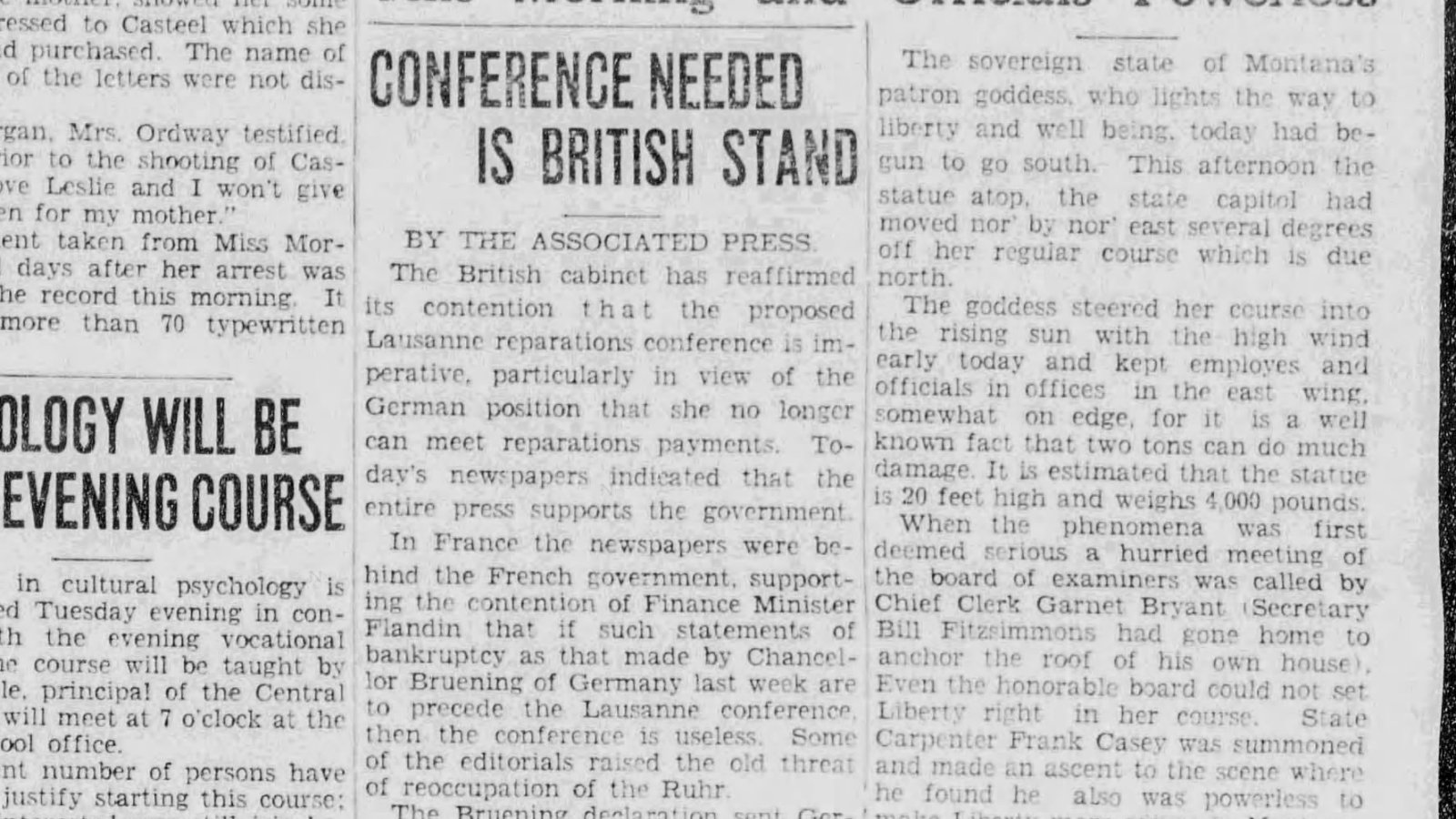
Long before Mike Hazen and Red Drennon patched the dome in 1980, and long before anyone knew who'd sculpted her or riveted two quarters to her cheeks, the newspapers were already following Lady Montana closely — mostly because the weather kept giving them a reason to. Here's the run of it, in order, from the Independent Record and The Montana Record-Herald.

January 11, 1932
A gale turns her around
A morning gale shifted the statue "nor' by nor' east several degrees off her regular course, which is due north," and kept the Capitol's own staff on edge — "it is a well known fact that two tons can do much damage." A hurried meeting of the state's board of examiners couldn't fix it: the state carpenter climbed up to look and "found he also was powerless to make Liberty more secure." Nobody could even reach the statue from outside the dome. The paper put her at 20 feet tall and 4,000 pounds — inflated compared to what's now known, but it tells you how little anyone actually knew about her at the time.

February 3, 1932
Anaconda riggers take the case
With Helena short on anyone qualified to scale the dome, capitol custodian J.E. Mushback sent for a rigging crew from the Anaconda smelter. They cut a manhole into the dome itself to reach her, then hauled up lumber, ropes, blocks and tackle, and acetylene welding equipment to make the repair.

February 4, 1932
Liberty statue to be anchored
Work got underway in earnest, with the plan being to anchor her securely enough that she wouldn't shift again.

February 22, 1932
Facing north again
The job took the Anaconda crew ten days. Superintendent C.A. Lemmon of the reduction works had sent over a foreman and three riggers, and for them it was "duck soup" — working 165 feet up, unbothered by winds that "seemed like another gale to folk on the ground." She was left "securely braced and bolted to the tip of the capitol dome," said to be good for "another half century."

June 28, 1932
Playful Lib flies a couple of kites
A lighter moment: two kids' kite strings blew loose and wrapped around the newly anchored statue's feet. The paper had fun with it — "Miss Liberty... flew two kites yesterday afternoon when their owners failed to hang on" — and reported she "took possession of both" until 5 o'clock, when she finally let them go.

July 14, 1932
Another gale, and a reminder of the last one
A summer storm smashed more than 150 street-lamp globes and, in recapping the damage, the paper looked back at the January gale that started all this: winds "more than 60 miles an hour" that had "turned the statue of Liberty on the capitol dome half way around" along with tearing off roofs and breaking windows across town.

June 15, 1933
The acting governor goes for a stroll
Senator Robert Pauline, acting governor while Governor Cooney was away, climbed into the dome and out a window at the statue's base to inspect the "ornamental metal fixtures," which he found "in pretty bad shape." He walked a foot-wide plank around the base, "perfectly at home," while Secretary of State Sam W. Mitchell wisely stayed down on the rotunda floor.

December 17, 1933
Anaconda offers a second gift of copper
"After more than 32 years of standing placidly on the crown of the dome... Miss Liberty is soon to be given a new 'understanding.'" Governor Frank H. Cooney announced the dome would be recovered in fresh, native Montana copper — about three and a half tons of sixteen-ounce sheet copper — as part of a repair program funded through the federal Civil Works Administration. The Anaconda Copper Mining Company offered to donate the metal outright; general manager James R. Hobbins wired from New York that the company "will be very glad to provide this poundage of copper f.o.b. Helena without charge to the state." It's the same company that would donate copper again, 47 years later, for the Hazen and Drennon repair in 1980.

December 29, 1933
The recoppering gets underway
CWA crews began stripping the dome's old aluminum paint and laying the new copper sheathing, part of a much larger wave of Depression-era work on the Capitol — rewiring, repainting offices, and expanding the parking area — that put "scores of CWA workers" to work that winter.